

No. 278 – A sinking fund may prove to be most tax efficient
Question
We have a family trust that holds a portfolio consisting of unit trusts and shares. We recently sold some of these investments and were shocked to see how much capital gains tax we are paying.
The trust will soon be receiving a lump sum from my late mother’s estate. Should we invest this money through the trust, or would it be better to distribute the funds to the beneficiaries immediately?
Answer
Your concern is entirely understandable. Many families establish trusts to protect their wealth for future generations, only to discover that the tax treatment of investments held within those trusts can be particularly punitive.
Tax
Under the current South African tax rules, an ordinary family trust pays income tax at a flat rate of 45%. When an investment is sold at a profit, 80% of the capital gain is included in the trust’s taxable income. At a tax rate of 45%, this translates into an effective CGT rate of 36%.
Individuals, by comparison, include only 40% of their capital gains in taxable income, resulting in a maximum effective CGT rate of 18%. This means that a trust retaining a capital gain can pay twice as much CGT as an individual in the highest tax bracket.
There is an important exception. Under certain circumstances, capital gains realised by a trust can be vested in South African resident beneficiaries and taxed in their hands rather than in the trust. This needs to be done correctly and within the applicable tax rules.
A family trust can provide valuable protection and continuity. It allows trustees to manage investments for children and grandchildren and can help preserve family wealth across generations.
Assets held in a properly structured discretionary trust will also generally fall outside the personal estates of beneficiaries who do not have vested ownership rights. This can have important estate planning benefits.
If you distribute the inheritance to the beneficiaries and they invest it in their own names, those assets will form part of their personal estates. You may therefore reduce future investment taxes but potentially increase estate duty exposure and lose some of the protection and flexibility the trust was intended to provide.
Sinking fund
A clever way to reduce tax payable by the trust is to have the trust invest the inheritance through a sinking fund.
A sinking fund is an investment structure offered by life insurance companies. It works in much the same way as a modern endowment policy, except that there is no life assured. This makes it particularly suitable for trusts. Depending on the provider, the trust can invest in a wide range of unit trusts, shares and managed funds.
The important difference is how the investment returns are taxed
The tax rate for a sinking fund is 30%, while capital gains are taxed at an effective rate of 12%. Compare this with the 45% income tax rate and 36% CGT rate applicable to income and gains retained in an ordinary trust.
In other words, the effective CGT rate within the sinking fund can be just one-third of the rate paid by the trust on direct investments. That is a substantial potential saving as can be seen in the example below:
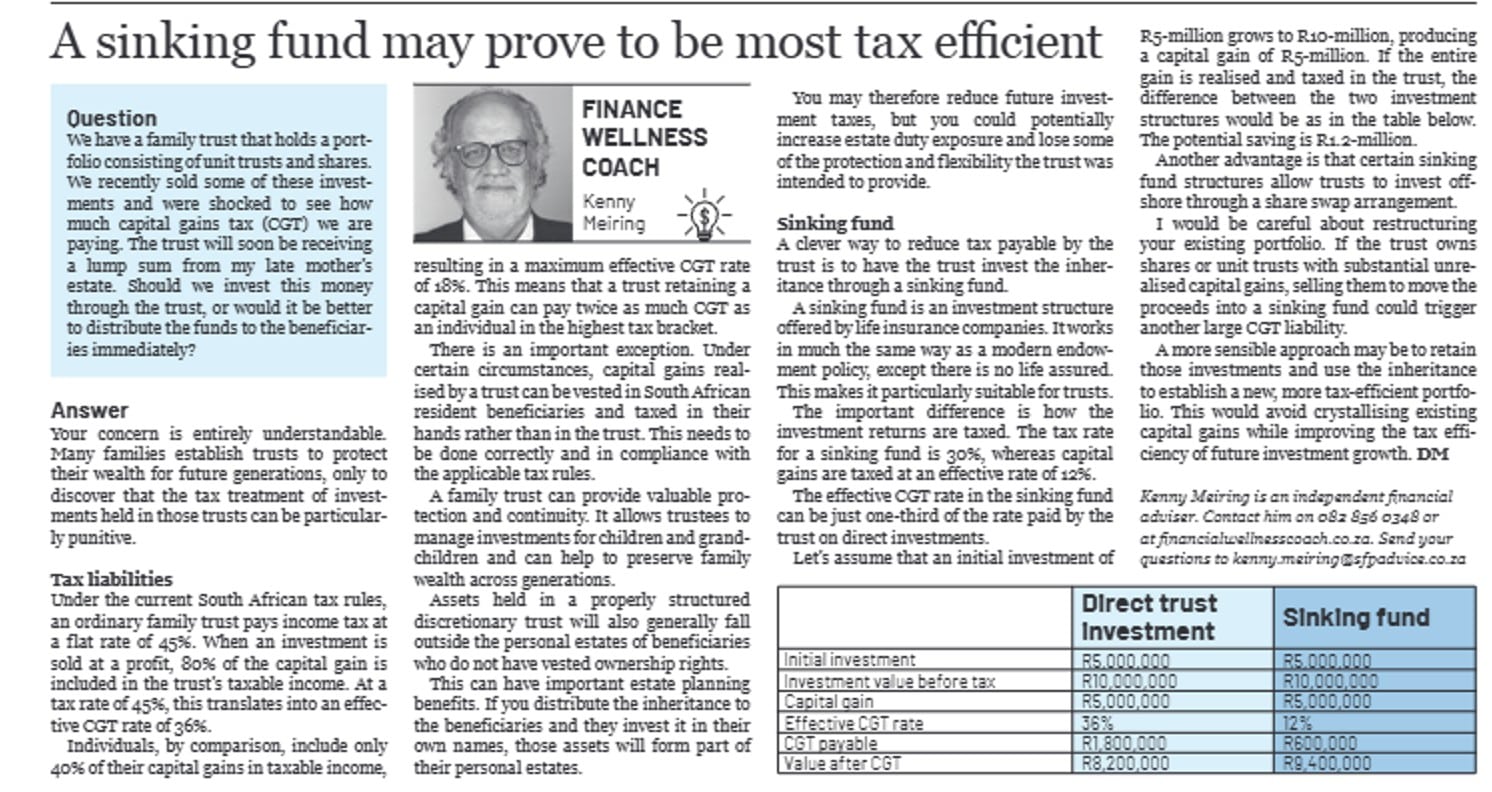
Let’s assume that an initial investment of R5 million grows to R10 million, producing a capital gain of R5 million. If the entire gain is realised and taxed in the trust, the difference between the two investment structures would be as follows:
|
Direct trust investment |
Sinking fund |
|
|
Initial investment |
R5,000,000 |
R5,000,000 |
|
Investment value before tax |
R10,000,000 |
R10,000,000 |
|
Capital gain |
R5,000,000 |
R5,000,000 |
|
Effective CGT rate |
36% |
12% |
|
CGT payable |
R1,800,000 |
R600,000 |
|
Value after CGT |
R8,200,000 |
R9,400,000 |
The potential saving is R1.2 million. That is money that could remain invested for future generations rather than being lost to tax. The comparison illustrates why choosing the correct investment structure matters.
Another advantage is that certain sinking fund structures allow trusts to invest offshore through a share swap arrangement. This can provide exposure to global share markets and other international. For a family looking to preserve wealth over several generations, offshore diversification can be just as important as tax efficiency.
I would be particularly careful about restructuring your existing portfolio. If the trust owns shares or unit trusts with substantial unrealised capital gains, selling them to move the proceeds into a sinking fund could trigger another large CGT liability.
A more sensible approach may be to retain those investments and use the inheritance to establish a new, more tax-efficient portfolio. This would avoid unnecessarily crystallising existing capital gains while improving the tax efficiency of future investment growth.
Good financial planning is about finding the right balance between protecting assets, managing tax and ensuring that as much of your wealth as possible eventually reaches the people you intended to benefit.
KENNY MEIRING IS AN INDEPENDENT FINANCIAL ADVISER
Contact him via phone, email or via contact phone on the financialwellnesscoach.co.za website
Read more of our articles on the Daily Maverick website or newspaper weekly!
 adminfwc
No. 279 – Keeping a business in the family, safely and fairly
adminfwc
No. 277 – Weighing up property against a balanced fund
adminfwc
No. 276 – Protecting your family finances while freelancing
adminfwc
No. 275 – Money in the bank could cost you more in tax
adminfwc
No. 274 – Weighing up rental income against long-term investment growth
adminfwc
No. 273 – Three effective ways for passing wealth to grandchildren
adminfwc
No. 272 – Plan ahead for business ownership after death
adminfwc
No. 271 – Planning for living and having money left to leave after your death
adminfwc
No. 270 – Making sure that where there is a will, there is clarity, not chaos
adminfwc