

No. 271 – Planning for living and having money left to leave after your death
Question
I am 65 and have a retirement fund worth R5 million. I want an income, but I also want to leave something to my son when I die. What should I do?
Answer
Balancing the income you need today with the desire to leave capital to your family later is a challenge that affects many South Africans.
There are several options, but no single product gives you the highest income along with certainty, full access to capital and a guaranteed inheritance. I will run through a number of options you can consider so that you and your planner can make a better decision
- Living annuity
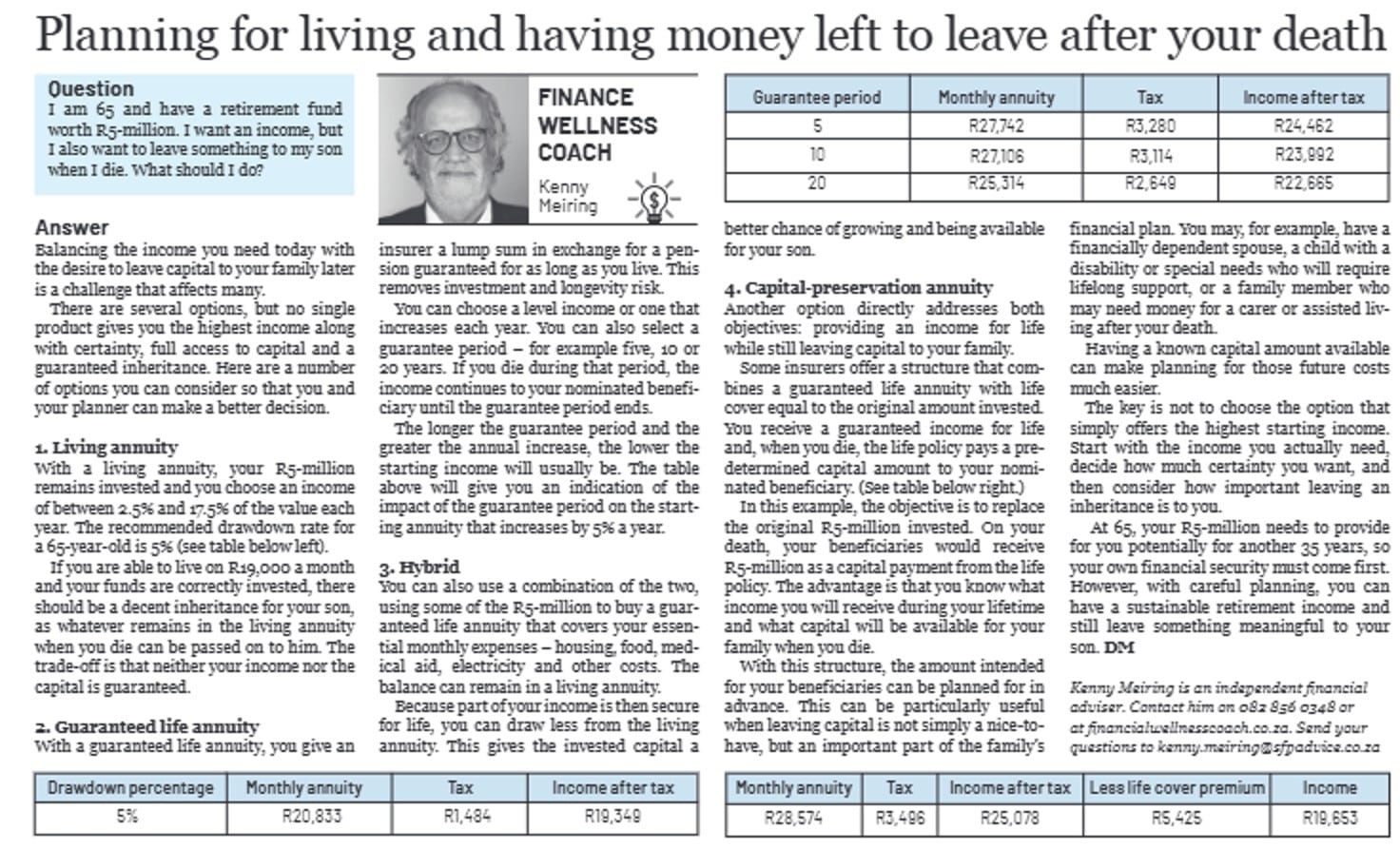
With a living annuity, your R5 million remains invested and you choose an income of between 2.5% and 17.5% of the value each year. The recommended drawdown rate for a 65-year-old is 5%.
|
Drawdown percentage |
Monthly annuity |
Tax |
Income after tax |
|
5% |
R20,833 |
R1,484 |
R19,349 |
If you are able to live on R19 000 a month, and your funds are correctly invested, there should be a decent inheritance for your son as whatever remains in the living annuity when you die can passed on to him. The trade-off is that neither your income nor the capital is guaranteed.
- Guaranteed life annuity
A guaranteed life annuity works differently. You give an insurer a lump sum in exchange for a pension guaranteed for as long as you live. This removes investment and longevity risk.
You can choose a level income or one that increases each year. You can also select a guarantee period – for example five, 10 or 20 years. If you die during that period, the income continues to your nominated beneficiary until the guarantee period ends.
The longer the guarantee period and the greater the annual increase, the lower the starting income will usually be. The table below will give you an indication of the impact of the guarantee period on the starting annuity that increases by 5% a year:
|
Guarantee Period |
Monthly annuity |
Tax |
Income after tax |
|
5 |
R27,742 |
R3,280 |
R24,462 |
|
10 |
R27,106 |
R3,114 |
R23,992 |
|
20 |
R25,314 |
R2,649 |
R22,665 |
- Hybrid
You do not have to choose between a living annuity and a life annuity, you can use a combination of the two.
You can use some of the R5 million to buy a guaranteed life annuity that covers your essential monthly expenses – housing, food, medical aid, electricity and other costs that will not disappear. The balance can remain in a living annuity.
Because part of your income is then secure for life, you can draw less from the living annuity. That gives the invested capital a better chance of growing and being available for your son.
- Capital-preservation annuity
There is another option worth considering because it directly addresses both objectives: providing an income for life while still leaving capital to your family.
Some insurers offer a structure that combines a guaranteed life annuity with life cover equal to the original amount invested. You receive a guaranteed income for life and, when you die, the life policy pays a predetermined capital amount to your nominated beneficiary.
In this example, the objective is to replace the original R5 million invested.
|
Monthly annuity |
Tax |
Income after tax |
Less life cover premium |
Income |
|
R28,574 |
R3,496 |
R25,078 |
R5,425 |
R19,653 |
On your death, your beneficiaries would receive R5 million as a capital payment from the life policy.
The advantage is that you know what income you will receive during your lifetime and what capital will be available for your family when you die.
With a living annuity, the inheritance depends on how the investments perform, how much income you draw and how long you live. With this structure, the amount intended for your beneficiaries can be planned for in advance.
This can be particularly useful where leaving capital is not simply a nice-to-have, but an important part of the family’s financial plan.
You may, for example, have a financially dependent spouse, a child with a disability or special needs who will require lifelong support, or a family member who may need money for a carer or assisted living after your death. Having a known capital amount available can make planning for those future costs much easier.
It can also be useful where there is a significant age difference between spouses. If you want a pension for your spouse, the insurer takes both spouses’ ages into account because the income may have to continue until the second spouse dies. Where one spouse is considerably younger, this can result in a significantly lower starting income. An alternative could be to provide the older spouse with a single-life annuity and use the capital-preservation benefit to provide a lump sum for the surviving spouse when the annuitant dies.
The key is not to choose the option that simply offers the highest starting income. Start with the income you actually need, decide how much certainty you want, and then consider how important leaving an inheritance is to you.
At 65, your R5 million needs to provide for you potentially for another 35 years, so your own financial security must come first. However, with careful planning, you can have a sustainable retirement income and still leave something meaningful to your son.
KENNY MEIRING IS AN INDEPENDENT FINANCIAL ADVISER
Contact him via phone, email or via contact phone on the financialwellnesscoach.co.za website
Read more of our articles on the Daily Maverick website or newspaper weekly!
 adminfwc
No. 272 – Plan ahead for business ownership after death
adminfwc
No. 270 – Making sure that where there is a will, there is clarity, not chaos
adminfwc
No. 269 – Preserving property while treating children fairly
adminfwc
No. 268 – Access bonds can boost emergency savings, but discipline is vital
adminfwc
No. 267 – The case for giving children an early inheritance
adminfwc
No. 266 – Three principles to guide investment decisions
adminfwc
No. 265 – US asset may not be the best bet when it comes to estate planning
adminfwc
No. 264 – Turning property proceeds into a tax-efficient retirement income
adminfwc
No. 263 – How to plan for your pets’ care after your death
adminfwc