

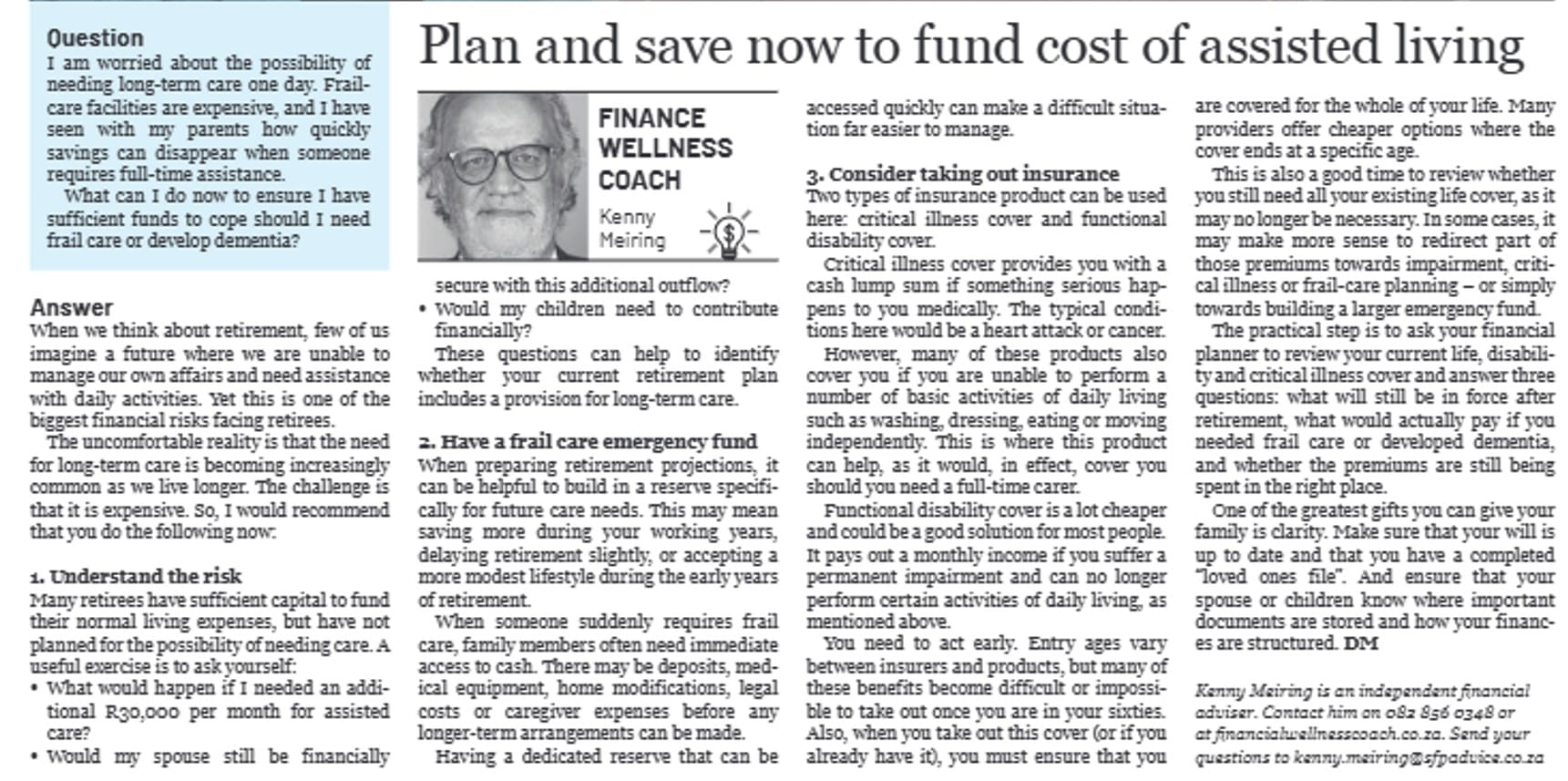
No. 259 – Plan and save now to fund cost of assisted living
Question
I am worried about the possibility of needing long-term care one day. Frail care facilities are expensive, and I have seen how quickly savings can disappear when someone requires full-time assistance.
What can I do now to make sure I have sufficient funds available should I eventually need frail care or develop dementia?
Answer
When we think about retirement, we often picture travelling, spending time with grandchildren, taking up hobbies, or simply enjoying a slower pace of life. Very few of us imagine a future where we are unable to manage our own affairs and need assistance with daily activities.
Yet this is one of the biggest financial risks facing retirees.
The uncomfortable reality is that many of us will spend their final years needing some form of assistance. Whether it is due to dementia or simply the effects of ageing, the need for long-term care is becoming increasingly common as we live longer.
The challenge is that long-term care is expensive.
I would recommend that you do the following now:
- Understand the risk
Living for a very long time while becoming increasingly dependent on others is probably the most underestimated risk when it comes to retirement.
Many retirees have sufficient capital to fund their normal living expenses but have not specifically planned for the possibility of needing care.
A useful exercise is to ask yourself:
- What would happen if I needed an additional R30,000 per month for assisted care?
- Would my spouse still be financially secure with this additional outflow?
- Would my children need to contribute financially?
These questions can help identify whether your current retirement plan includes a provision for long-term care.
- Keep an emergency fund for frail care
When preparing retirement projections, it can be helpful to build in a reserve specifically for future care needs.
This may mean saving more during your working years, delaying retirement slightly, or accepting a more modest lifestyle in the early years of retirement. When someone suddenly requires frail care, family members often need immediate access to cash. There may be deposits, medical equipment, home modifications, legal costs, or caregiver expenses before any longer-term arrangements can be made.
Having a dedicated reserve that can be accessed quickly can make a difficult situation far easier to manage.
- Consider taking out insurance
There are two types of insurance product that you can use here:
- Critical illness
- Functional disability
Critical illness cover provides you with a cash lump sum if something serious happens to you medically. The typical conditions here would be a heart attack or cancer.
However, many of these products also cover you if you are unable to perform a number of basic activities of daily living such as washing, dressing, eating or moving independently. This is where this type of product can help as it would effectively cover you should you need a full-time carer
Functional disability cover is a lot cheaper than critical illness cover and could be a good solution for most people. This pays out a monthly income if you suffer a permanent impairment and can no longer perform certain activities of daily living. These may include basic functions such as washing, dressing, eating, moving around the home or transferring from a bed to a chair.
You need to act early. Entry ages vary between insurers and products, but many of these benefits become difficult or impossible to take out once you are in your sixties. Also, when you take out this cover (or if you already have it) you must ensure that you are covered for the whole of your life. Many providers offer cheaper options where the cover ends at a specific age.
This is also a good time to review whether you still need all their existing life cover. Once the children are financially independent, the bond is lower or the retirement capital is in place, large amounts of life cover may no longer be necessary. In some cases, it may make more sense to redirect part of those premiums towards impairment, critical illness or frail-care planning — or simply towards building a larger emergency fund.
The practical step is to ask your financial planner to review your current life, disability and critical illness cover and answer three questions: what will still be in force after retirement, what would actually pay if you needed frail care or developed dementia, and whether the premiums are still being spent in the right place.
- Have the difficult conversations early
If you were suddenly unable to manage your own affairs, would your family know what to do? Who would you like to administer your affairs?
One of the greatest gifts you can give your family is clarity. Ensure that your will is up to date and that you have a completed Loved Ones File. Make sure your spouse or children know where important documents are stored and how your finances are structured.
Retirement planning is not only about funding the years when you are healthy and independent. It is also about ensuring that, if life takes an unexpected turn, you and your family have options.
KENNY MEIRING IS AN INDEPENDENT FINANCIAL ADVISER
Contact him via phone, email or via contact phone on the financialwellnesscoach.co.za website
Read more of our articles on the Daily Maverick website or newspaper weekly!
 adminfwc
No. 272 – Plan ahead for business ownership after death
adminfwc
No. 271 – Planning for living and having money left to leave after your death
adminfwc
No. 270 – Making sure that where there is a will, there is clarity, not chaos
adminfwc
No. 269 – Preserving property while treating children fairly
adminfwc
No. 268 – Access bonds can boost emergency savings, but discipline is vital
adminfwc
No. 267 – The case for giving children an early inheritance
adminfwc
No. 266 – Three principles to guide investment decisions
adminfwc
No. 265 – US asset may not be the best bet when it comes to estate planning
adminfwc
No. 264 – Turning property proceeds into a tax-efficient retirement income
adminfwc