

No. 240 – Weighing up the pros and cons of RAs and tax-free investments
Question
I pay tax at the 45% marginal rate and want to invest R3 000 a month for the next 10 years. Should I use a retirement annuity or a tax-free investment for my savings? I do not own any tax free or retirement investments.
Answer
Both tax-free investments and retirement annuities have meaningful advantages. The choice you make depends on what is more important to you – flexibility or tax efficiency.
The tax-free investment option
Tax-free investments are appealing because of their simplicity. All the growth is free of tax. Withdrawals are not taxed. There are no access restrictions and no future tax consequences to manage.
Unlike retirement investments, tax-free investments are not subject to Regulation 28, which gives you more investment freedom and, potentially, higher long-term returns.
The main limitation is the contribution cap. Investors are restricted to R36 000 per year, with a lifetime limit of R500 000.
The retirement annuity option
Retirement annuities offer a benefit that no tax-free investment can replicate: the upfront tax deduction.
Contributions to a retirement annuity are deductible up to 27.5% of your taxable income. For an individual paying tax at 45%, this represents a significant immediate saving.
Like tax-free investments, retirement annuities grow free of income tax, dividends tax and capital gains tax. However, access to the funds is restricted until you reach the age of 55.
At retirement, up to one-third may be taken as a lump sum, subject to the retirement lump-sum tax table, and the remaining two-thirds must be used to purchase an annuity. Income drawn from that annuity is taxable.
These restrictions are material and should not be ignored. The question is whether the tax benefit compensates for them. The example below should help quantify the benefit:
Example
A contribution of R3 000 per month equals R36 000 per year, or R360 000 over 10 years before growth. Assume a tax-free investment earns 10% per year due to the absence of Regulation 28 limits, while a retirement annuity earns a more conservative 8% per year.
After 10 years, the outcomes are as follows:
|
Investment |
Return |
Value after 10 years |
|
Tax-free |
10% |
R620 000 |
|
Retirement annuity |
8% |
R550 000 |
The impact of the tax saving on the RA
We need to account for the tax saving that you get with the RA premiums.
At a marginal tax rate of 45%, contributing R3 000 per month to a retirement annuity generates a tax saving of R1 350 per month, or R16 200 per year. Over 10 years, the cumulative tax saving is R162 000.
If these annual tax savings are invested separately into a tax-free investment at a 10% annual return, they grow to approximately R260 000 over the same period.
Comparing the outcomes
Option 1: Tax-free investment only
Value after 10 years: approximately R620 000.
All proceeds are completely tax free and can be accessed at any time, either as an income stream or through ad hoc lump-sum withdrawals.
Option 2: Retirement annuity with tax savings reinvested
Total value after 10 years: approximately R810 000.
This consists of a retirement annuity value of around R550 000, of which one-third (R183 333) may be taken as a lump sum at retirement, likely falling within the tax-free portion of the retirement lump-sum table, and two-thirds (R366 667) must be used to purchase an annuity.
In addition, the accumulated value of the tax savings invested over the period amounts to approximately R260 000 in a tax-free investment.
This results in a total tax-free lump sum of roughly R443 000, with the same flexibility as a tax-free investment, plus an annuity of R366 667. At a 5% drawdown rate, this annuity would provide an income of approximately R18 000 per year, taxed at the marginal rate applicable at the time.
Which option produces the better outcome?
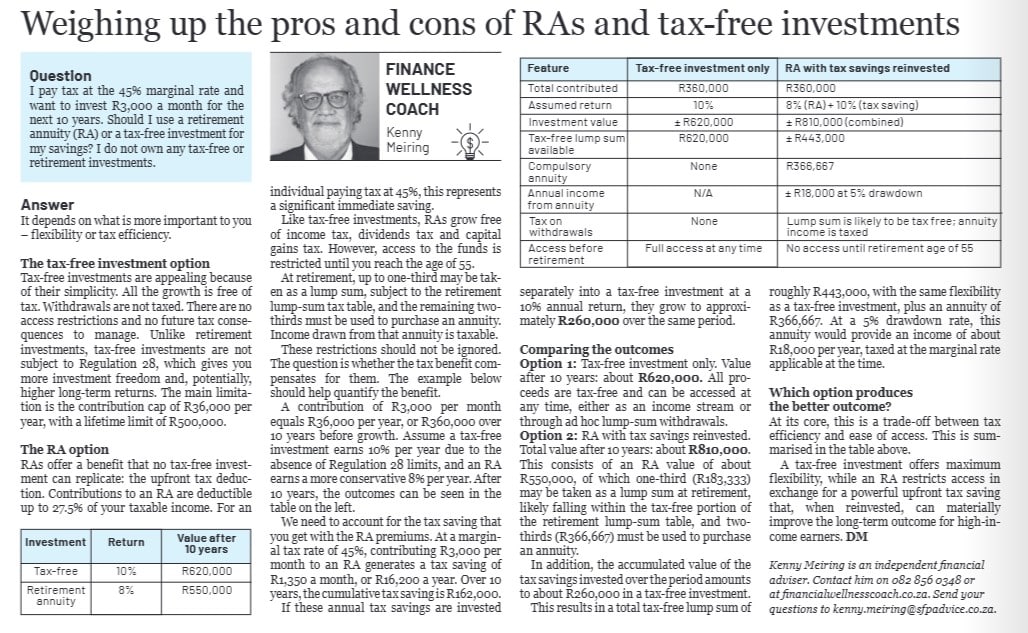
At its core, this is a trade-off between tax efficiency and ease of access. This is summarized below:
|
Feature |
Tax-free investment only |
RA with tax savings reinvested |
|
Total contributed |
R360 000 |
R360 000 |
|
Assumed return |
10% |
8% (RA) + 10% (tax saving) |
|
Investment value |
± R620 000 |
± R810 000 (combined) |
|
Tax-free lump sum available |
R620 000 |
± R443 000 |
|
Compulsory annuity |
None |
R366 667 |
|
Annual income from annuity |
N/A |
± R18 000 at 5% drawdown |
|
Tax on withdrawals |
None |
Lump sum likely tax free; annuity income taxed |
|
Access before retirement |
Full access at any time |
No access until retirement age of 55 |
A tax-free investment offers maximum flexibility, while a retirement annuity restricts access in exchange for a powerful upfront tax saving that, when reinvested, can materially improve the long-term outcome for high-income earners.
KENNY MEIRING IS AN INDEPENDENT FINANCIAL ADVISER
Contact him via phone, email or via contact phone on the financialwellnesscoach.co.za website
Read more of our articles on the Daily Maverick website or newspaper weekly!
 adminfwc
No. 272 – Plan ahead for business ownership after death
adminfwc
No. 271 – Planning for living and having money left to leave after your death
adminfwc
No. 270 – Making sure that where there is a will, there is clarity, not chaos
adminfwc
No. 269 – Preserving property while treating children fairly
adminfwc
No. 268 – Access bonds can boost emergency savings, but discipline is vital
adminfwc
No. 267 – The case for giving children an early inheritance
adminfwc
No. 266 – Three principles to guide investment decisions
adminfwc
No. 265 – US asset may not be the best bet when it comes to estate planning
adminfwc
No. 264 – Turning property proceeds into a tax-efficient retirement income
adminfwc