

No. 209 – Ensure less estate duties with all-round benefits
Question
I am 82 years old and have R20 million invested in unit trusts. My son will inherit everything, but I am worried about him investing a lump sum like this as he has a gambling problem.
I recently did an estate planning exercise and was horrified to see that these unit trusts would trigger around R4 million in estate duty.
What would you recommend that I do in order to reduce this liability and ensure that my son does not spend his inheritance recklessly?
Answer
I would need to take a look at your full financial situation before being able to make a proper recommendation. I will, however, talk about what mechanisms you can consider to reduce your estate duty and the structures that you can put in place to prevent your son from being reckless with his inheritance.
Reducing estate duty
When it comes to estate duty, your retirement funds fall outside of your estate and will not trigger estate duty.
This is why it is often useful to do a full estate analysis when you retire. We can structure your affairs to be both tax efficient while you’re on pension and also ensure that when it comes to inheritance, your estate will pay the least amount of estate duty.
In order to get this R20 million out of your estate, we can use a financial structure called “disallowed retirement contributions”. You get a tax break on any retirement contributions up to a limit of 27.5% five your taxable income or R350,000, depending on the which amount is lower. Anything more than this amount is classed as a disallowed contribution.
So, if you sell your R 20 million worth of unit trusts and buy a “one day “retirement annuity the bulk of this investment will be classed as a disallowed contribution. You would then mature this retirement annuity and use the proceeds to set up a living annuity.
Because the living annuity was set up with the proceeds of these disallowed contributions, any income that you take from this annuity would not be taxable. This is a fantastic benefit – you get a tax free income while the capital is growing tax free living annuity.
When you pass away, if your son continues to receive the proceeds of the living annuity as an income, the remaining value of the disallowed contributions will not trigger estate duty. Should he elect to receive the benefits as a lump sum, then these disallowed contributions would trigger estate duty.
Protecting the inheritance
In order to ensure that your the son does not cash in the proceeds of the living annuity and trigger millions in estate duty, you could do the following:
- set up a trust and make the trust the beneficiary of the living annuity
- create a letter of wishes inside your will instructing the trustees to take over the living annuity upon your death and use the proceeds to provide your son with an income.
You now have a situation where the disallowed contributions fall outside of your estate and your son would be receiving an ongoing income instead of a lump sum which could be squandered.
The income from the living annuity would be taxable in your son’s hands. If he is still working and does not need the income, he could ask the trustees to keep the living annuity drawdown at the lowest rate of 2.5% until such time he needs additional income or retires.
Setting up these structures is quite complex, and I have just given a broad overview of what could be done. I would certainly recommend that you get the help of an experienced financial planner to assist you.
KENNY MEIRING IS AN INDEPENDENT FINANCIAL ADVISER
Contact him via phone, email or via contact phone on the financialwellnesscoach.co.za website
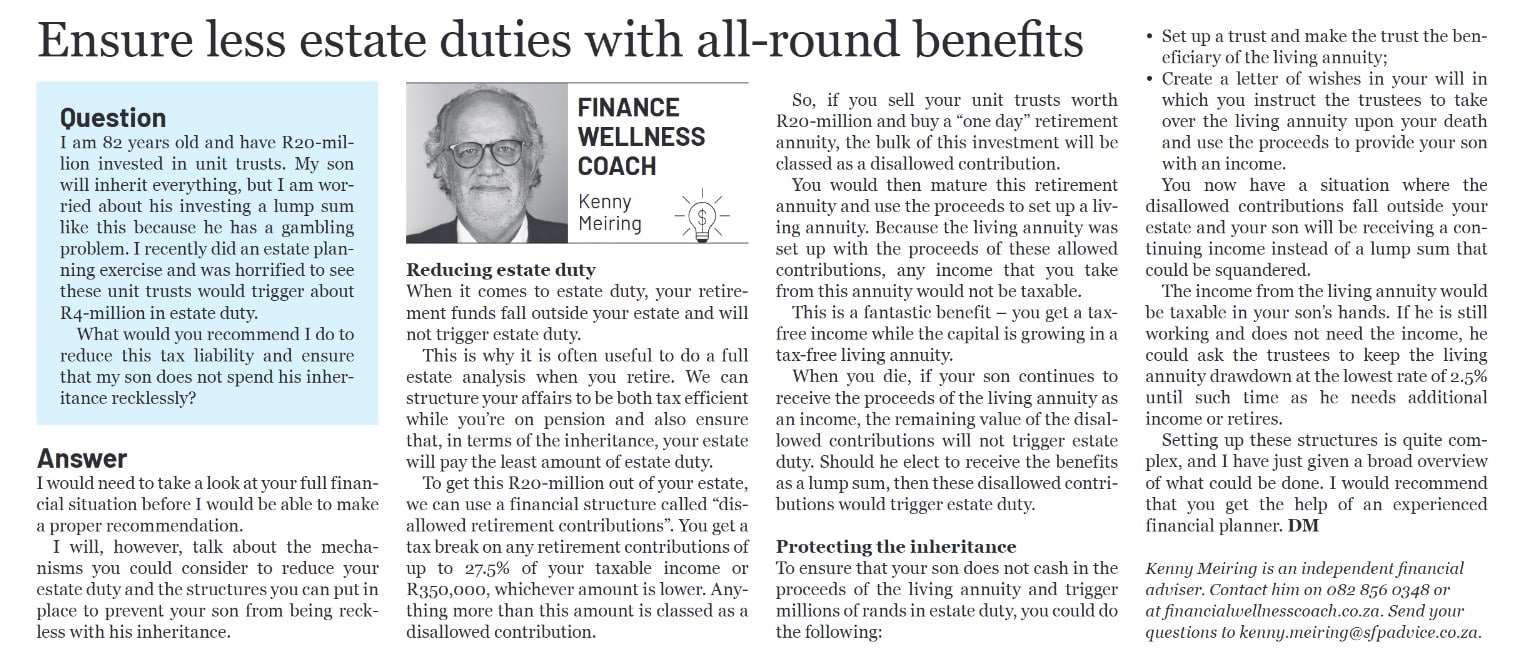
Read more of our articles on the Daily Maverick website or newspaper weekly!
 adminfwc
No. 272 – Plan ahead for business ownership after death
adminfwc
No. 271 – Planning for living and having money left to leave after your death
adminfwc
No. 270 – Making sure that where there is a will, there is clarity, not chaos
adminfwc
No. 269 – Preserving property while treating children fairly
adminfwc
No. 268 – Access bonds can boost emergency savings, but discipline is vital
adminfwc
No. 267 – The case for giving children an early inheritance
adminfwc
No. 266 – Three principles to guide investment decisions
adminfwc
No. 265 – US asset may not be the best bet when it comes to estate planning
adminfwc
No. 264 – Turning property proceeds into a tax-efficient retirement income
adminfwc